
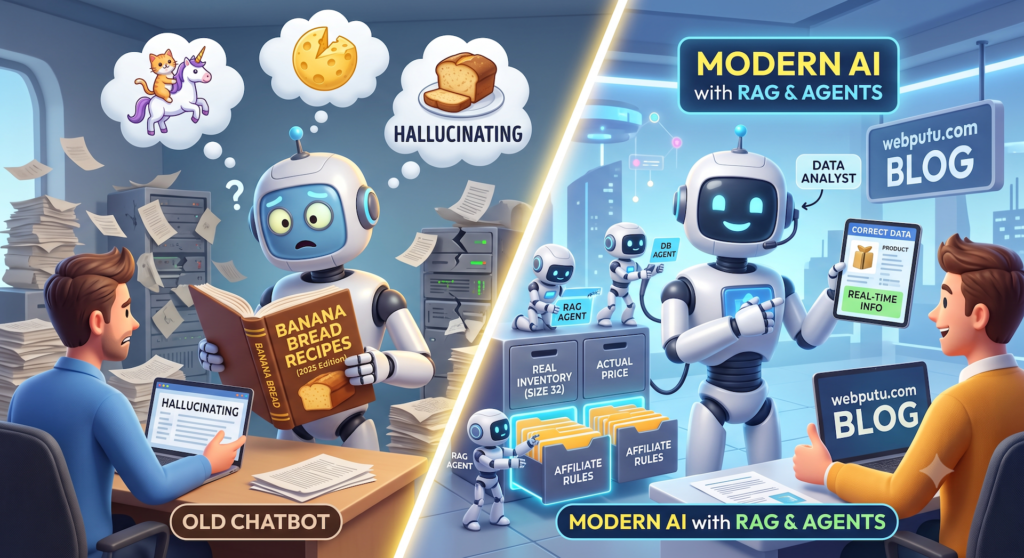
We’ve all been there. You ask a website’s customer service chatbot a simple question like, “How do I apply a discount to my order?” and it responds with a highly enthusiastic, incredibly detailed recipe for banana bread.
For the last couple of years, Artificial Intelligence has been a bit like that one friend at trivia night who has no idea what the answer is, but says it with such absolute, unwavering confidence that you almost believe them. In the tech world, we call this a “hallucination.” In the real world, we call it “incredibly annoying.”
But as we cruise through 2026, the software world is getting a massive upgrade. We are finally teaching AI how to read the room.
Here is a layman’s guide to the tech that is fixing the internet’s robot problem.
The Problem: The “Know-It-All” Brain
Think of a standard AI model (like the brains behind basic chatbots) as a genius who has read every book in the world, but has been locked in a basement since 2023.
If you run an e-commerce store and a customer asks the AI, “Do you have those baggy cargo pants in a size 32?” the AI panics. It doesn’t know what is in your warehouse. It doesn’t know your inventory database. So, to avoid looking dumb, it just makes something up: “Yes! And they are made of moonbeams!”
Obviously, if you are building serious software—like a multi-tenant invoicing app or a complex store plugin—you can’t have your AI making up its own pricing rules.
The Fix: RAG (The Open-Book Test)
Enter the savior of modern tech: Retrieval-Augmented Generation, or RAG for short. (Yes, it sounds like an angry metal band, but stick with me).
Instead of letting the AI guess the answer from memory, RAG forces the AI to take an open-book test. Here is how it works:
- The customer asks a question.
- The system puts the AI on “hold.”
- It rapidly searches your specific, real-time business documents (like your current inventory, refund policies, or affiliate rules).
- It hands those exact documents to the AI and says: “Read this, and only this, before you open your digital mouth.”
The result? The AI suddenly sounds like a certified genius who actually works for your company.
The Evolution: AI Agents (Your Digital Minions)
If RAG is the open-book test, Agent Orchestration is hiring a team of hyper-focused interns.
Instead of asking one giant AI to do everything, developers are now breaking things down. When you type a request into a modern app, a “Manager Agent” looks at it and starts delegating:
- “Hey, Database Agent! Go check the Laravel backend to see if this user paid their bill!”
- “Policy Agent! Read through the refund rules!”
- “UI Agent! Make sure the answer looks pretty on our Vue.js frontend!”
These agents talk to each other in milliseconds, figure out the perfect answer, and hand it back to you. It’s like magic, but with way more Python and FastAPI running behind the scenes.
What This Means For You
If you are just a regular user browsing the web, the good news is that chatbots are finally about to become genuinely helpful. You’ll spend less time screaming “SPEAK TO A HUMAN” at your screen.
If you are a developer, the days of slapping a basic AI widget onto a website and calling it a day are officially over. The future is about building smart, specialized, behind-the-scenes systems that actually know what they are talking about.
And thankfully, they will finally stop offering you banana bread recipes when you just want to return a pair of shoes.